Learns How Sensors Interact
Engineers can inspect which sensors affect which, and how long each effect takes

One pretrained model encodes the patterns in your time-series history as so every forecast, alert, and recommended fix starts from what your business already knows.
Example C3 AI application: a regional flu forecast showing national wILI of 1.85%, a CHARM 8-week median forecast of 2.25% with a 1.24–4.22% range, a severity map of 54 regions and a region table.
Example application using CDC ILINet data. Not an official public-health forecast.
CHARM produces the 8-week forecast zero-shot, with no model trained on this dataset
The shaded range comes from CHARM’s 99 quantiles, so planners can see the high and low cases along with the most likely path
Neighboring regions go in as extra channels, and CHARM learns how they move together
One model forecasts all 54 regions, with no per-region model to build or maintain
Example C3 AI application: an asset anomaly monitor for a fleet of pumps, with pump P-104 flagged at an anomaly score of 0.94, sensor trends and three similar past events.
Illustrative example with simulated sensor data.
CHARM scores how far this pump’s behavior sits from its own normal history, with no failure labels
CHARM reads pressure, current and vibration together, using a short description of each sensor
CHARM finds the closest past events by comparing embeddings, so engineers start from what worked before
Example C3 AI application: an explainability chat for pump P-104. The engineer asks whether to be concerned, and the agent answers that it looks like early bearing wear, citing three similar past cases and their expert notes, with a suggested next step.
Illustrative example with simulated sensor data and expert notes.
A reasoning agent on the C3 Agentic AI Platform writes the answer from the retrieved cases, their notes and CHARM’s forecasts
CHARM finds these cases by comparing the new window’s embedding with every past window, then attaches the notes experts wrote at the time
Every claim points to the past case it came from, so engineers can check the evidence
Example C3 AI application: an Expert Companion chat. It flags a window on pump P-106 with retrieval confidence 0.41, below the 0.60 threshold, and asks the expert to label it. The expert answers cavitation from a blocked suction strainer, and the label is added to the annotated history. Weekly review requests fall from 14 to 3.
Illustrative example with simulated sensor data and expert answers.
CHARM scores how well a window matches its history. Below the threshold, it asks an expert instead of guessing
The expert’s answer is stored as a label on this window, in the same embedding space CHARM searches
As labels build up, fewer windows fall below the threshold, so experts are asked less often
What changes when one pretrained model takes the place of many custom ones
Most time-series models stop at the forecast, and CHARM keeps going
Engineers can inspect which sensors affect which, and how long each effect takes
Every forecast carries 99 quantiles, with no training on your data
Learns normal from each asset’s own history and flags what falls outside it
A small classifier reached 99.8% valve accuracy on held-out UCI Hydraulic data
Search history for moments like now, and group assets that behave alike
Comparisons describe forecasting-first time-series foundation models in general.
Follow CHARM from the first unusual signal to a clear next step, whether it comes from a pump, a demand plan or a supplier
Go behind the scenes with CHARM on sample industrial equipment data. The same steps work on demand, lead times and other business time series.
01
CHARM learns what normal looks like from each asset’s own history. When new readings drift away from that pattern, it raises an alert, even for a type of failure it has never seen. There are no labels to collect and no model to train.
In supply chain
A sudden jump in demand for one product, or a supplier’s lead times drifting past the promised date, stands out against its usual pattern.
02
For each alert, CHARM finds the past events that look most like it, along with the notes your experts recorded at the time. An agent on the C3 Agentic AI Platform turns those cases into a plain-language answer and a suggested next step.
In supply chain
Ask why demand went up or whether a supplier will deliver on time, and CHARM finds past spikes or late deliveries that looked like this one, with the planners’ notes on what caused them.
03
When CHARM isn’t confident about a match, it asks a subject matter expert to review the case. Each answer joins its history, so it needs to ask less often over time.
In supply chain
When a demand spike matches nothing on record, a planner labels the cause, and the next spike like it is matched to that note.
CHARM ranks first in anomaly detection and similar-event retrieval, and top 5 of 91 models in forecasting
Top 5of 91 models
by average CRPS rank on GIFT-Eval, zero-shot, and top 6 by mean CRPS. Top 4 in Sales, Web/CloudOps and Nature
CRPS rank by domain, of 91 models, lower is better · average rank 37.03
#1on TSB-AD
First on both the univariate and multivariate tracks of the official leaderboard
VUS-PR, higher is better · ● pretrained model · leaderboard of Oct 20, 2026
80.9%accuracy
vs. 78.5% for the next-best model
UEA multivariate benchmark, 19 datasets
#1on READ-Bench
NDCG@10 of 0.687, ahead of 0.645 for MantisV2, a supervised model
NDCG@10, higher is better · best pipeline per encoder · READ-Bench, 12 datasets
| Task | Benchmark | CHARM | Standing | Model |
|---|---|---|---|---|
| Forecasting | GIFT-Eval, 91 models, zero-shot | CRPS 0.478 · avg. CRPS rank 37.03 | Top 5 by average CRPS rank and top 6 by mean CRPS; top 4 in Sales (2nd), Web/CloudOps (3rd), Nature (4th); best zero-shot model in Sales | CHARM |
| Anomaly detection | TSB-AD-U / TSB-AD-M | VUS-PR 0.68 / 0.54 | 1st on both; zero-shot variant 3rd on both | CHARM |
| Anomaly detection | UCR, 46 datasets | Adjusted F1 0.754 | 1st, 24 wins | Research encoder |
| Classification | UEA, 19 datasets | 80.9% avg accuracy | 1st, 5 wins | Research encoder |
| Retrieval | READ-Bench, 12 datasets | NDCG@10 0.687 | Best pipeline, with label-aware reranking | Research encoder |
CHARM: the model behind the API. Research encoder: the 7.1M-parameter model from the ICML 2026 paper. On TSB-AD, CHARM uses the asset’s normal training data as its reference; the zero-shot variant uses none.
CHARM reads every signal alongside a description of what it measures and learns how signals relate over time
CHARM Architecture
01
Description-conditioned temporal convolutions
Every channel is paired with a short text description, such as “pump outlet pressure.” CHARM converts that description into an embedding and uses it to shape how the channel’s readings are processed, starting at the first layer. A temperature sensor and a vibration sensor are read differently from the start.
Classification accuracy on the UEA benchmark when the first layer uses descriptions, ignores them, or splits signals into fixed patches. Ablation on the 7.1M-parameter research encoder.
02
Gated, lag-aware cross-channel attention
Attention runs across every channel and time step. For each pair of signals, a learned gate decides whether one should inform the other, and a lag term accounts for delays, such as oil temperature rising some time after load does.
The grid shows which channels each channel draws on, for six load channels (HUFL to LULL) and oil temperature (OT). Use the toggle to highlight the OT row or column.
On power-transformer data, oil temperature draws on every load channel, and no load channel draws on oil temperature. That matches the physics, since load heats the oil, and CHARM found it without supervision. Engineers should treat links like this as leads to confirm. Schematic of the pattern reported in the paper (Fig. 5); cell values are illustrative.
03
Channel-order equivariance
CHARM does not depend on the position of a column. Teams can send the same channels in any order, from any site’s data layout, and get the same output.
Largest difference in output after shuffling channel order at random, measured on eight datasets.
04
Self-supervised JEPA training
During training, CHARM hides part of a signal and learns to predict a summary of the hidden part from what it can see. Learning at the level of patterns makes the embeddings reusable across tasks and less sensitive to sensor noise.
Removing one component at a time shows how much each contributes. The training objective has the largest effect, followed by matching each channel to its description.
Hover over or select a row to see what each component does.
Δ UEA accuracy, percentage points · Source: ICML 2026 paper, Table 32.
The four design choices above were tested on a 7.1M-parameter research encoder. The model you call through the API builds on it with patching and a quantile decoder, so it reads longer histories and returns a full range with every forecast.
Specifications from the model card. Research results come from the encoder described in the ICML 2026 paper. Embeddings and forecasts are served from separate checkpoints, which may differ in patch size and embedding dimension.
Run CHARM on Microsoft Azure, through the API, or in your own environment
Deploy CHARM through your existing Azure account and start with your own data.
Use the Python SDK or your coding agent. Get started with the guide below.
Talk to our team about deploying CHARM where your data already lives.
Install the SDK, send your first time-series data and read back forecasts and embeddings in a few lines of Python
Python 3.10 or newer.
pip install c3-charm
export CHARM_BASE_URL=https://your-charm-server:8080
export CHARM_API_KEY=your-api-keyUse the server URL and key you receive with access.
from charm import CharmClient

client = CharmClient(timeout=300)
print(client.model_info())Raw units, time-major, one name per channel.
fc = client.prediction.create(
    descriptions=[["load_mw", "ambient_temp_c"]],
    ts_array=[series.tolist()],
    target_len=48, return_tensors="np",
)
point = fc.median # (1, 48, 2)Install the CHARM skill, describe the job in plain language, and invoke it with /charm.
# Claude Code
claude plugin marketplace add https://huggingface.co/c3aiia3c/CHARM.git
claude plugin install charm@c3-charm

# Cursor
git clone https://huggingface.co/c3aiia3c/CHARM
cp -r CHARM/skills/charm ~/.cursor/skills/charmclient.embeddings.createOne vector per series, or per-patch, per-channel vectors. Use them for search, clustering, anomaly scoring, and features.
emb = client.embeddings.create(
    descriptions=descriptions * len(windows),
    ts_array=windows, return_tensors="np",
).embeds # (N, D)client.prediction.createForecasts with a median and the full quantile distribution. Negative target_len backcasts.
fc = client.prediction.create(
    descriptions=descriptions, ts_array=ts_array,
    target_len=48, return_tensors="np",
)
q = fc.denormalized_predictions # (1, 48, C, 99)| Goal | Approach | Effort |
|---|---|---|
| Forecast with uncertainty | Zero-shot prediction | None |
| Similar-event search, unlabeled anomalies | Embeddings + nearest neighbors | Minutes |
| Features for an existing model | Embeddings + scikit-learn | Minutes |
| Classification, reconstruction, custom forecasting | Toolkit head on frozen embeddings | Minutes on CPU |
| Input | Requirement |
|---|---|
| Length | 1 to 8,192 steps. Aim for 48 or more. |
| Channels | No hard limit. Memory grows roughly with C². |
| Request size | N × C × T ≤ 500,000. Series in one request share T and C. |
| Descriptions | Required, one per channel, such as “oil_pressure,” not “col_0.” |
| Scaling | Send raw units. CHARM normalizes internally. |
| Latency | Under 1 second at p99 for typical requests (batch of 8 or fewer). Forecasts for 32 series at once take longer, so run them as batch jobs. |
| Throughput | About 23 embedding requests or 12 forecast requests per second on one T4 GPU, and the endpoint autoscales. |
With no time axis, use gradient boosting.
Under about 48 steps, prefer classical methods.
Validate calibration before relying on the quantiles.
Links that match physics are encouraging, but they aren’t a causal-discovery guarantee.
Key specifications at a glance, with the full card available to download
Research papers, documentation and product guides for CHARM
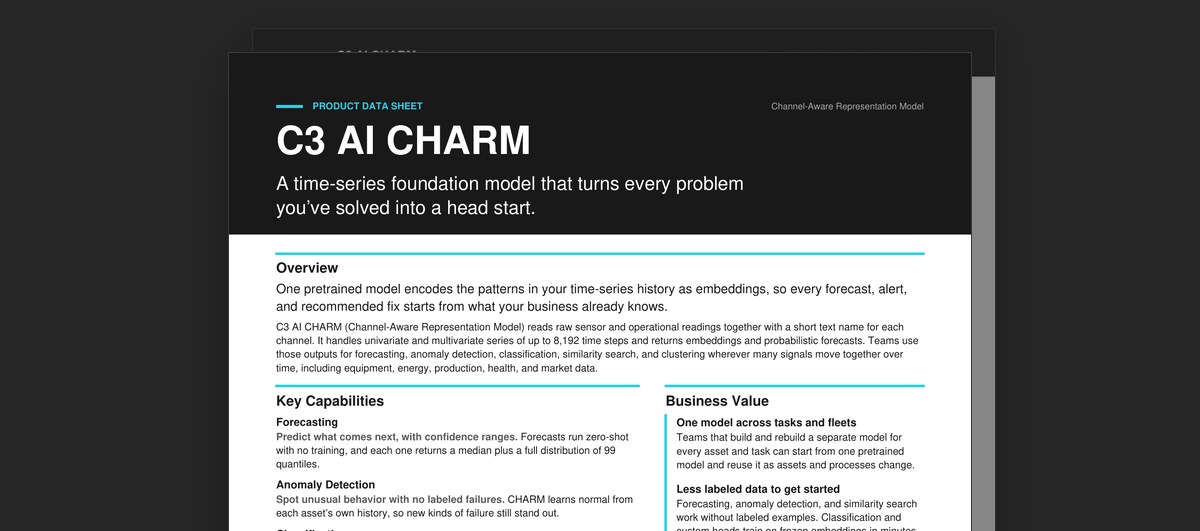 Data SheetDownload the Data Sheet
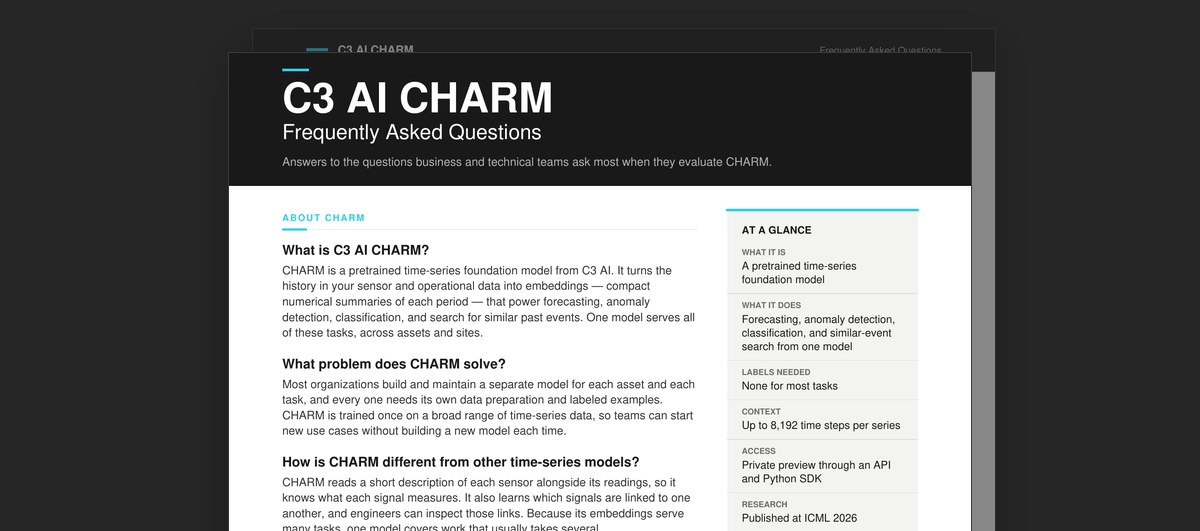 Frequently Asked QuestionsDownload the FAQ
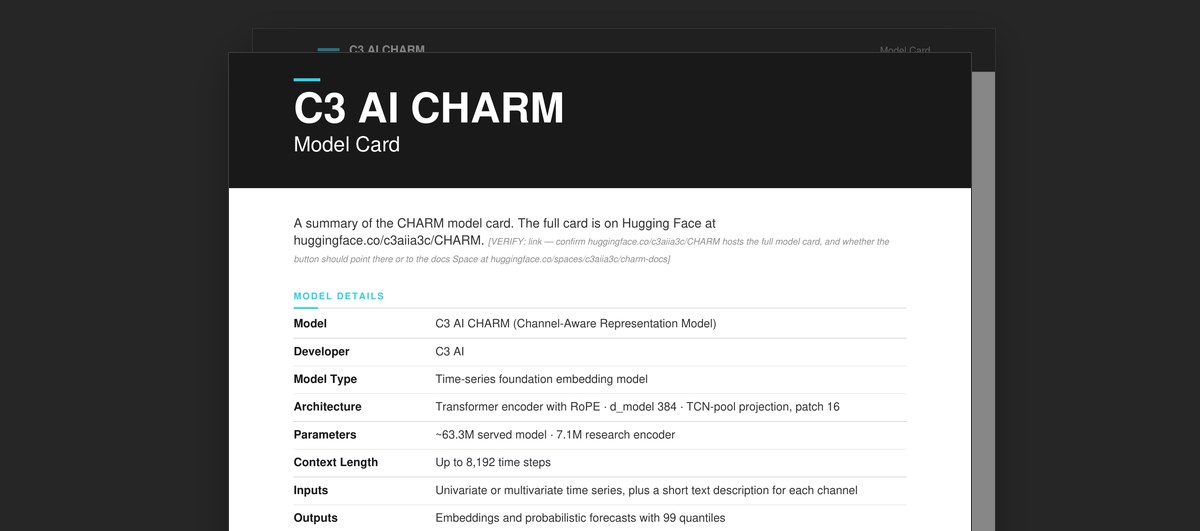 Model CardDownload the Model Card