






Integrated Steel Manufacturer Reduces Energy Consumption and Sulfur Emissions with AI-Driven Process Optimization
Value-Driven Benefits
20%
reduction in sulfur emissions through improved H2S removal
12%
reduction in electricity consumption, equivalent to 2,000 homes
24
weeks to production-ready AI application
Download the PDF to read the full story — Download
Introduction
A leading US-based coke and steel manufacturer operates largescale coke production operations that supply metallurgical coke and process gas to integrated steelmaking facilities. These operations include cryogenic gas processing units responsible for cleaning coke oven gas prior to downstream combustion in furnaces and ovens.
Challenges
The gas cleaning process relies on arrays of compressors to maintain cryogenic vessel temperatures. These compressors consume tens of thousands of horsepower depending on operating conditions, equivalent to the electrical usage of 12,000-16,000 homes. Separation performance must also remain high to remove hydrogen sulfide (H2S) from the gas stream and prevent excessive sulfur emissions, which are strictly governed by environmental compliance standards.
This creates a complex operational challenge in which engineers must dynamically balance energy efficiency, process stability, and emissions control. More aggressive setpoints can reduce energy consumption but increase the risk of thermal instability. Operators also have limited visibility into how changes in operating conditions affect tradeoffs between electricity consumption and H2S separation performance. Without advanced decision support, operators must rely on experience and manual adjustments to manage these tradeoffs, making it difficult to consistently operate the system at optimal efficiency.
Solution
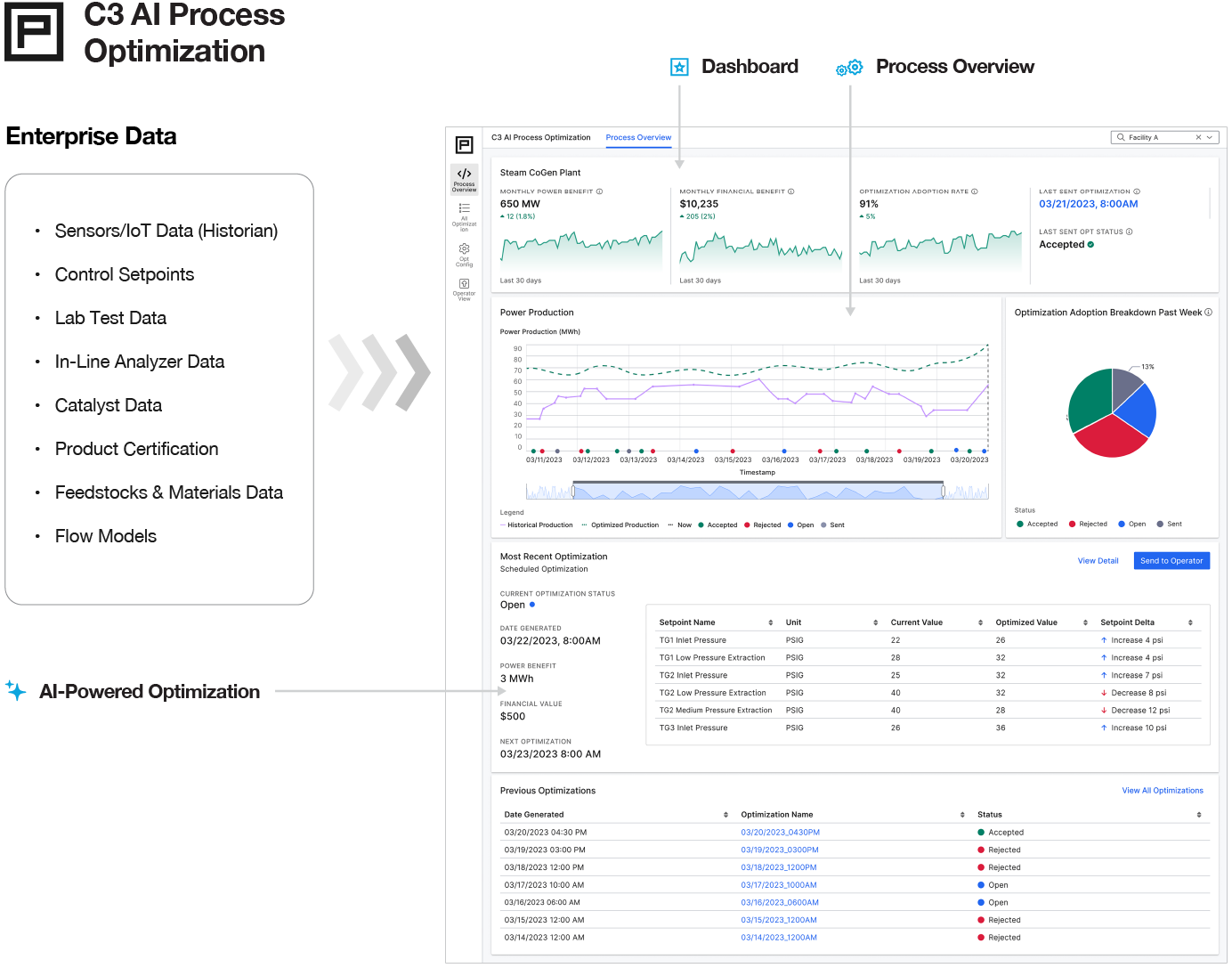
To address these challenges, the company partnered with C3 AI to implement C3 AI Process Optimization, an AI-driven application that recommends optimal setpoints to improve efficiency while operating within defined process and safety constraints. Within 26 weeks, the joint team integrated four years of historical operational data and real-time inputs from more than 1,000 sensors to configure and train predictive machine learning models and optimization engines for the cryogenic gas processing system. With C3 AI Process Optimization, operators and engineers can now review AI-driven recommendations that balance electricity consumption, H2S separation performance, and process stability, enabling operators to improve energy efficiency while maintaining process stability and product quality.
Results
With C3 AI Process Optimization, the company achieved a 20% reduction in sulfur emissions and reduced electricity consumption by more than 12%, equivalent to the continuous average power load of approximately 2,000 homes. The deployment also improved operational consistency by reducing variability in setpoint adjustments across shifts. Building on the success of the initial production deployment, the company is expanding C3 AI Process Optimization to additional assets and evaluating new optimization opportunities across its global operations.
About the Company
- $20+ billion in annual revenue
- 25+ million tons of annual steel production capacity
- Major integrated steel operations across North America and Europe
- 22,000+ employees
Project Highlights
- 26-weeks from kickoff to production deployment
- 1,000+ sensors integrated
- Four years of historical performance data used for model training
- Multiple predictive machine learning models deployed as optimization constraints
- Two optimizers configured using MILP optimization and nearest neighbor techniques
- Production-grade application delivering regular setpoint recommendations
Solution Architecture
Proven results in weeks, not years

Get insights into C3 AI’s capabilities, enterprise AI best practices, and highest-value use cases.
Gain insights into the C3 AI Platform's capabilities, its model-driven architecture, and test it against your company's sample data set.
Identify a high-impact business problem and collaborate with the C3 AI team to rapidly build an AI application that solves it.
Scale and deploy a tested C3 AI application into production. Incorporate user feedback and optimize algorithms to drive maximum economic value.
Take the Next Steps

Learn how our industry-leading Enterprise AI software products can help your organization.
Contact us at IR@C3.ai to learn more about investing at C3 AI.
For all other questions, please contact us here.