




By Vivek Bhushan, Senior Industry Solutions Director, C3 AI
Today’s supply chains operate in a world of constant change. Shifting demand, evolving constraints, and tightly coupled networks mean planning decisions carry sweeping impacts. Born out of this complexity, the future of supply chain planning will be driven by agentic systems that learn, adapt, and work alongside human planners. By embedding institutional and domain expertise into specialized agents, organizations have the ability to continuously sense change, evaluate trade-offs, and make financially grounded decisions. In this model, AI augments planners, acting as a trusted digital teammate that brings context and speed to every planning horizon. Agentic supply chain planning empowers both individuals and organizations to foresee and act on disruptions at the pace demanded by modern, global networks.
Why Current Systems Fall Short
Most supply chain planning systems in use today were designed for a slower, more predictable world. These systems depend on rigid rules, periodic batch updates, and fragmented data sources. As soon as a plan is finalized, it begins drifting out of sync with actual conditions, from forecasts and inventory positions to supplier and logistics disruptions. Disruption forces planners into manual triage, sifting through multiple systems and reconciling spreadsheets, emails, and databases. Often, the resulting decisions are made under pressure, with incomplete or conflicting information.
A deeper issue is that most tools cannot represent the financial implications of operational decisions. When a planner expedites freight, reallocates inventory, or shifts production, the downstream impact on revenue, margins, working capital, or ESG is rarely visible in real time. As a result, decisions are made in isolation: departments and teams don’t have the chance to confer about their workstreams, so each function focuses on improving its local metric while the system as a whole degrades.
What is predictable are the consequences of these outdated systems: rising costs, inconsistent service, and reactive decision-making that trades short-term stability for long-term performance. The result is a supply chain that appears optimized on paper, yet remains brittle when conditions change. Agentic supply chain planning solves for this disparity. By linking decisions, execution, and economics in real time, organizations can anticipate disruption and make proactive changes, without waiting for the next planning cycle.
Reimagining Supply Chain Planning with Agentic AI
In this context, agentic supply chain planning completely changes how decisions are made. Agentic systems embed domain knowledge directly into the planning workflows that teams use every day, allowing planning, simulation, and execution to happen continuously. Purpose-built agents support decisions across sales and operations execution, sales and operations planning, and the annual operating plan. Trade-offs are modeled across demand, supply, capacity, inventory, and financial constraints, giving planners a clear view of how operational decisions shape downstream financial outcomes.
With support from agentic systems, supply chain planners are empowered to automate repeatable tasks, and they’re guided through high-impact decisions with data-driven recommendations. Agents surface issues early to recommend corrective actions and show downstream impacts. As a result, daily execution is aligned with key financial objectives, with the flexibility to adapt plans as the business evolves.
Agentic Planning in Action
Consider the following scenario at a consumer goods company: a sudden, unpredicted surge in demand hits a major metropolitan region, putting immediate pressure on deployed inventory and threatening a sharp drop in case fill rates (CFR). A supply chain planner is called on to remedy the situation and prevent a stockout, in which her inventory can no longer meet customer demand, exposing revenue risk.
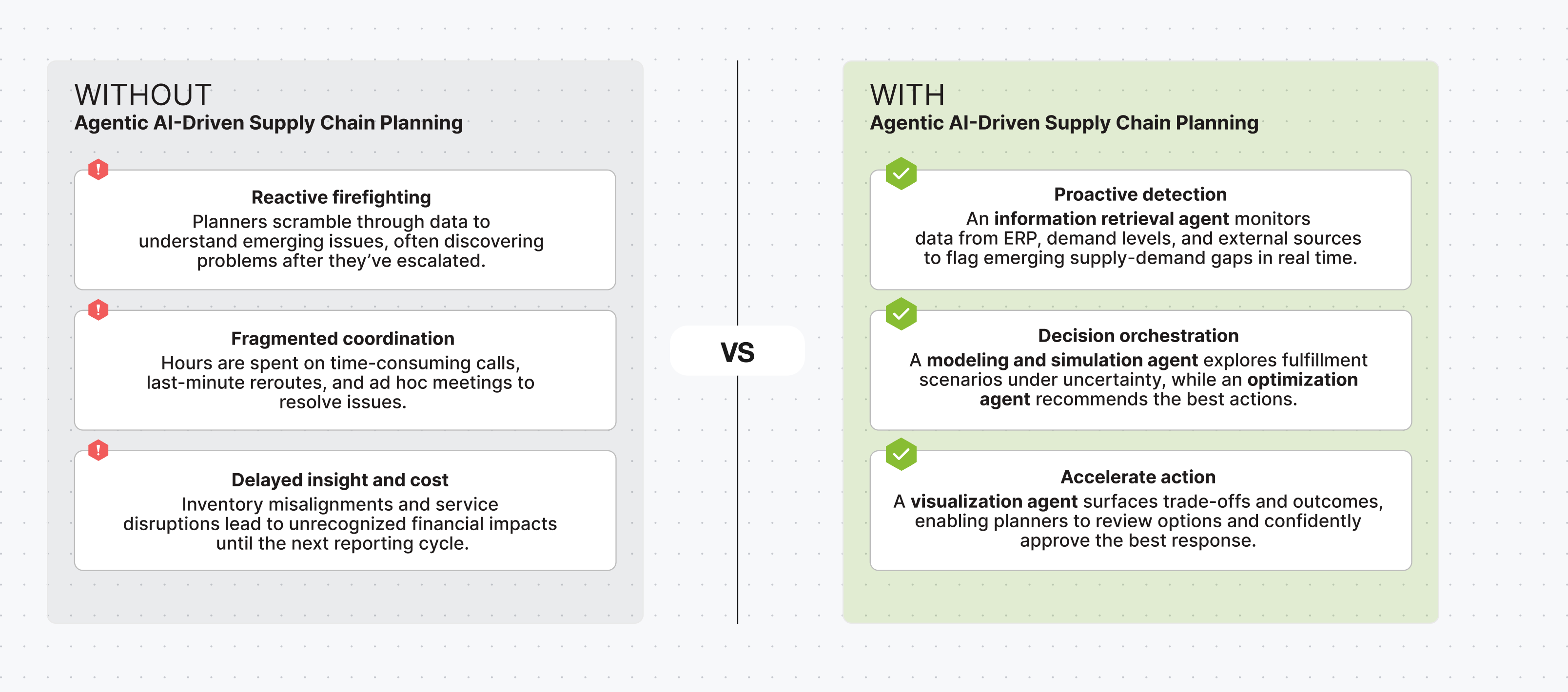
In legacy planning approaches, our planner might spend hours or even days in reaction mode to such a demand surge. Deep issues and fragilities in the supply chain are unearthed only after they’ve escalated to critical issues, and teams suffer through fragmented coordination efforts to resolve problems. The misalignments in inventory, previously invisible, create downstream financial implications that will surface in the next reporting cycle.
With an agentic-driven approach, purpose-built agents surface different courses of action as the situation unfolds. A visualization agent presents trade-offs in each scenario, showing how each option affects service levels and financial outcomes. Through human-in-the-loop review points within the orchestrated workflows, the planner stays in the driver’s seat, while agents minimize complexity in her decision processes. Spare inventory is quickly identified in a nearby demand center and redeployed to the affected region, protecting case fill rates and keeping execution aligned with financial objectives.
C3 AI’s Agentic Supply Chain Planning
The C3 AI Supply Chain Suite is designed to support planning as an always-on decision system, one that continuously evaluates constraints, objectives, and economic impact as conditions change. The C3 Agentic AI Platform powers agentic orchestration to connect data from ERP systems, planning tools, and external sources, applying learned expertise across planning horizons. Leveraging breakthrough technologies like STAFF (Specification to Tiny Agent Fine-Tuning) and multi-hop orchestration agents, the C3 AI Supply Chain Suite converts vast and siloed data sources into a rich foundation that supports a dynamic, self-improving network of AI agents.
These specialized agents have distinct responsibilities like sensing change, evaluating scenarios, or recommending actions. They learn from outcomes and the planners’ institutional knowledge, creating a horizon that improves over time and stays aligned with real operational conditions. Organizations can operate with greater agility, consistency, and trust in the decisions that shape their supply chains.
Agentic Orchestration in Supply Chain Planning and Execution
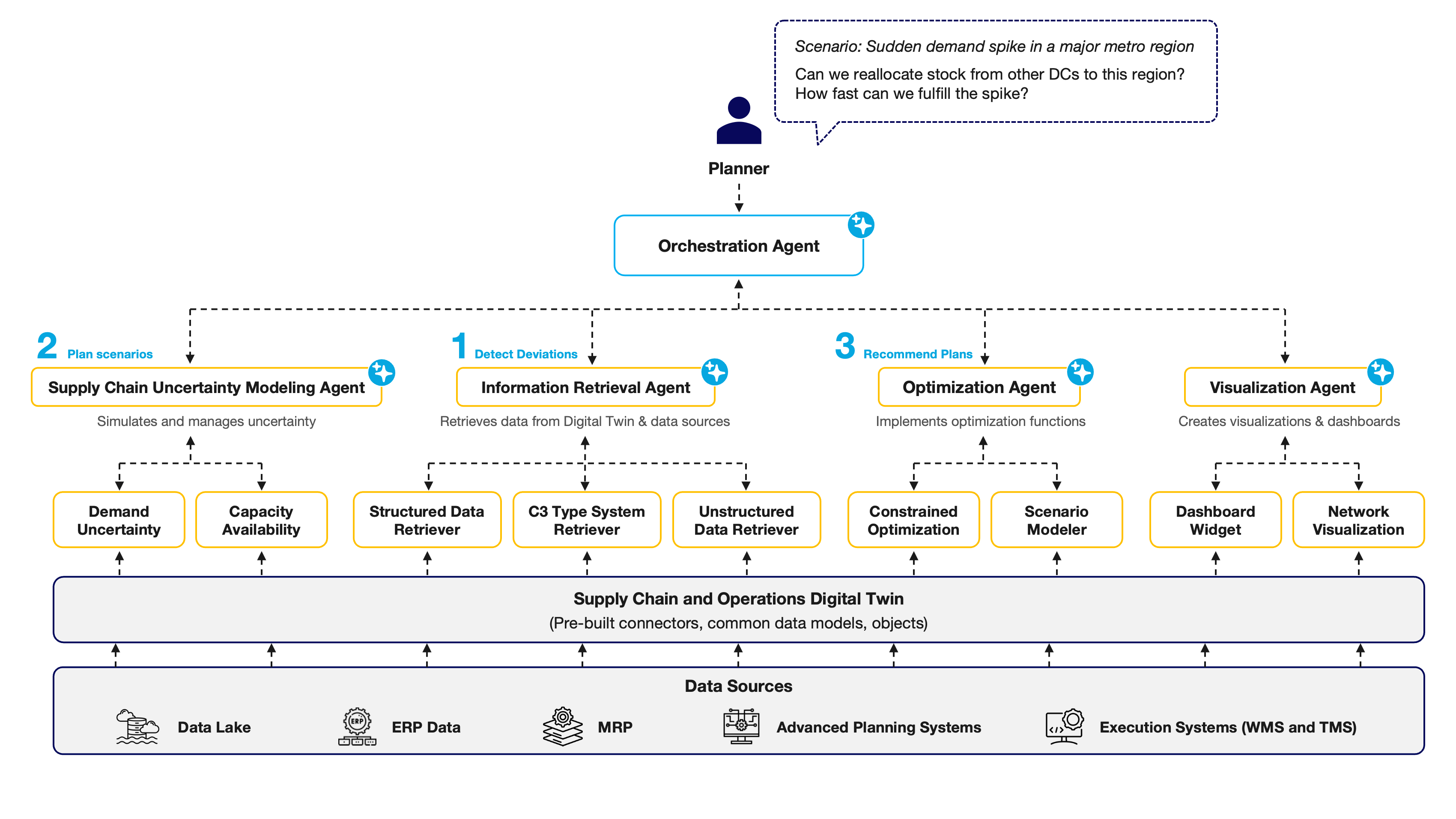
Figure 1: Agentic AI orchestrates supply chain planning and execution by coordinating a suite of specialized agents, each focused on a distinct task such as modeling, retrieval, optimization, or visualization. Agents work within a unified digital twin of the supply chain and draw from diverse enterprise data sources to support context-aware and financially-grounded decisions.
Agentic AI has fundamentally transformed many business processes by providing systems that continuously learn, adapt, and improve. Historical knowledge that once lived in emails or disparate spreadsheets is now captured and embedded into intelligent agents. These agents surface insights proactively, simulate trade-offs in real time, and recommend financially sound actions aligned to business goals. With agentic capabilities, supply chain planning can become an intelligent, self-improving system where every decision compounds into smarter business outcomes.
Want to see agentic planning in action? Schedule a demo to learn how C3 AI can transform your planning architecture.
About the Authors
Vivek Bhushan is a Senior Industry Solutions Director at C3 AI within the Product Management Group. He brings over a decade of experience in building and deploying AI-powered Supply Chain and Commercial solutions across industries. Prior to C3 AI, Vivek worked on developing digital and analytics-driven solutions at the intersection of supply chain strategy, AI/ML, and enterprise systems. He has successfully partnered with Fortune 500 organizations to scale AI implementations and deliver tangible business value. Vivek holds an MBA from Cornell University, a Master’s in Engineering Management from the University of Alberta, and a Bachelor of Science in Engineering from the Indian Institute of Technology (IIT) Kharagpur.